
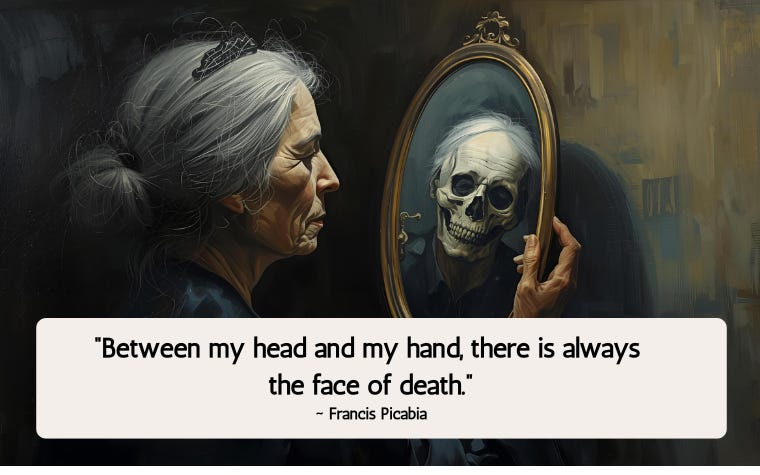
One morning my 87-year old mom asked me a very unusual question. She said, “Do you think it’s okay if I ask God to take me?”
I had to pause and think about my answer.
My mom was suffering. She was often scared. She hated being confused. And she knew her dementia would only get worse. (In fact, it had become so bad, my daughter had recently moved in to help her.)
After I pondered my mom’s circumstances, I told her I thought it was okay to ask God to take her – but I couldn’t guarantee her prayer would be answered in the way she wanted.
When she got up the next morning, she said, “I’m still alive aren’t I?”
I could tell she was sad she wasn’t dead. We chatted and reminisced about her life. One thing she said has stayed with me – “Well, I guess I’ll just do the best I can.”
I never expected to have either of the above conversations. But I’m glad I did because it made me think about my own demise.
When Mortality First Becomes Real
For most of my life, death existed as an abstract idea - something that happened to other people. It was distant and theoretical.
Although various relatives died, my own death was easy to ignore as I went about achieving my goals.
Even when my dad died, my own passing seemed remote. But something changed with that conversation with my mom. Suddenly, mortality wasn’t abstract anymore. It became deeply personal.
And brushing aside thinking about it seemed cowardly.
Maybe you’ve had the same realization. It might not have come from a conversation, but something has made you consider the questions of: “What am I doing with my life? How will people remember me? What do I want to do with the time I have left?"
These aren’t casual questions you quickly Google and be done with it. These questions probe the very core of your existence, demanding you reflect about your life and whether you're living it authentically or merely going through the motions.
How deeply these questions affect you depends on several factors—your personality, life experiences, support systems, and existing coping mechanisms. For some people, these questions whisper quietly during late night moments of solitude. For others, they arrive like a thunderclap, impossible to ignore or dismiss.
What makes this midlife reckoning particularly powerful is its timing. You're no longer young enough to believe you have unlimited time to figure things out, yet you're (hopefully) not so old that meaningful change feels impossible. You stand at a crossroads where awareness meets opportunity—if you're brave enough to lean into the discomfort rather than run from it.
Responding to Your Own Mortality
When you're faced with the stark reality that you will eventually die, you might surprise yourself with how intensely negative you become.
People display a range of responses[i] when they confront their own mortality. Some spiral into despair while others discover profound meaning in their lives.
If thinking about your own death is threatening, you’ll ignore it. Not attend funerals, steer conversations away from aging, or throw yourself into distractions.
When you’re scared, it’s hard to process reality – even if it’s sometime in the future.
At the other end of the spectrum, you might surprise yourself by viewing your new awareness as an opportunity for deeper self-understanding and growth.
Rather than seeing death as life's great enemy, you recognize it as life's great teacher. If you find yourself here, you understand intuitively what research has begun to confirm: that confronting your mortality, while initially uncomfortable, can lead to a richer, more intentional way of living.
Or perhaps you’re in the middle. You feel grounded in faith and spiritual beliefs.
The promise of an afterlife, reunion with loved ones, or continuation of your soul provides a buffer against death's finality. These beliefs don't eliminate the fear of dying, but they do offer hope that death isn't an ending. It’s just a transition to something else.
This perspective can bring tremendous peace and allow you to face mortality with greater calm.
Your initial reaction might be different than those listed above. What's fascinating is that none of these responses is permanent.
You might cycle through different reactions – even in the same day. The goal isn't to judge your initial response but to recognize that how you first react to your own mortality isn't necessarily how you must always react to it.
What matters is what you do with your increased insight.
Two Paths Forward
Studies consistently show that confronting your own mortality and physical decline creates a fork in the road, leading to one of two distinctly different outcomes.
The first path is profound anxiety and existential angst.
When you become aware that your body is aging and your time is limited, it can trigger what psychologists call "death anxiety." This is a deep, sometimes paralyzing fear that can dominate your thoughts and rob you of peace.
If you find yourself lying awake at 3 AM worrying about how your body is not aging well, or if thoughts of death send you spiraling into panic, you're experiencing this very human response. You're certainly not alone, and you're not weak for feeling this way.
The second path sparks a meaningful reevaluation of your priorities and goals.
This process often leads to what researchers describe as a "broader perspective on life"—a kind of clarity that comes from understanding, perhaps for the first time, what truly matters to you.
The difference between these two paths isn't about courage or character. It often comes down to how you frame the experience.
If you view your awareness of mortality as a problem to be solved or a threat to be eliminated, you're likely to experience anxiety. But if you can see it as information to be processed, like a wake-up call, you open the door to personal growth in how you spend your time ahead.
What's encouraging is you're not locked into whatever your initial reaction is. You can shift from anxiety to growth.
Making Death Less Frightening with Exposure Therapy
The same psychological principle used to help people overcome their fear of spiders can help you develop a healthier relationship with mortality.
This is called exposure therapy, It’s the gold standard for treating fears and phobias.
The basic idea is counterintuitive, but it works. Instead of avoiding what scares you, you gradually and deliberately expose yourself to it in a safe, controlled way.
For instance, a person who is afraid of dogs might start by looking at pictures of puppies. Then they watch some videos of friendly dogs. Then they observe dogs from a distance. Eventually this person tries petting a calm, well-trained dog.
With each exposure, the fear diminishes.
You can apply this same principle to your fear of death.
Instead of pushing thoughts of mortality away when they arise, you can learn to sit with them, examine them, and gradually become more comfortable with their presence.
This doesn't mean becoming morbid or obsessed. It means developing the ability to think about your own mortality without being overwhelmed by panic or despair.
When you deliberately confront thoughts of your own death in this way, something remarkable often happens: the terror begins to fade, and life starts to feel more meaningful. Why? Because recognizing that your time is limited makes that time more precious.
Scarcity creates value, whether we're talking about diamonds, concert tickets, or the years you have left.
Tip: You can use this with most of your fears – such as looking old, losing your mobility, or even getting Dementia.
This isn't just modern psychology talking. Buddhist monks have long practiced something called "death meditation." This where they focus on the nine stages of death in their own bodies. It’s kind of morbid, but as death is unavoidable, it does take the resistance of decline and death away.
Simply allowing yourself to think about your own mortality with curiosity, rather than terror, is a form of gentle exposure therapy that can transform your relationship with death. And it can help you focus on your time ahead.
The Journey of Reevaluation
When you’re ready to confront your mortality head-on, one shift that can help you is considering the two types of virtues. These are resume virtues and eulogy virtues.
Resume virtues are exactly what they sound like—the skills, achievements, and accomplishments that look impressive on paper.
These are the things you've used most of your life, such as analyzing complex problems, managing teams, or creating innovative solutions. They're the external markers of success that society celebrates. They also form the backbone of most people’s professional identity.
Eulogy virtues, on the other hand, are the character traits and qualities of relationship that people remember about you after you're gone.
These things include kindness, loyalty, courage, honesty, and the ability to make others feel valued and understood. They're about who you are as a person, not what you accomplished.
While your resume virtues will decline as you get older, your eulogy virtues will increase.
Research suggests that in the decades over age 50, that this is when many people do their most meaningful work in developing character and deepening relationships.
This shift isn't just inevitable; it's inherently rewarding.
When you focus on developing eulogy virtues, you're not competing against younger, more energetic versions of yourself or others.
Instead, you're growing into something that only comes with time and experience: wisdom, perspective, and the kind of deep authenticity that emerges when you stop trying to impress others and start focusing on becoming the person you most want to be.
The beauty of focusing on eulogy virtues is that this work aligns perfectly with the natural process of aging. Instead of fighting against your changing capabilities, you're leaning into the unique strengths that come with having lived long enough to develop real wisdom and perspective.
Embracing Death as a Teacher
My mother's question about asking God to take her wasn't just about her suffering—it was about her recognition that death is not the enemy of life, but its ultimate teacher.
When she stated, "Well, I guess I'll just do the best I can," she was expresses acceptance, resilience, and the choice to live meaningfully, regardless of her circumstances.
You can do the same.
You can embrace aging. You can have an ongoing conversation with yourself about what it means to live well.
After all, the most important journey isn't toward a destination you can reach, but toward becoming the person you're meant to be along the way.
I hope you, like me, are trying to confront your fears of aging and dying. Getting Dementia still scares me, but I am slowly becoming more comfortable confronting it.
Don’t stop believing,
~Julie
[i] Ideas and research statistics have been paraphrased from Cohen, Gene D. (2006) The Mature Mind: The Positive Power of the Aging Brain, Perseus Books Group; AND Brooks, Arthur C. (2022). From Strength to Strength: Finding Success, Happiness, and Deep Purpose in the Second Half of Life. Penguin.