
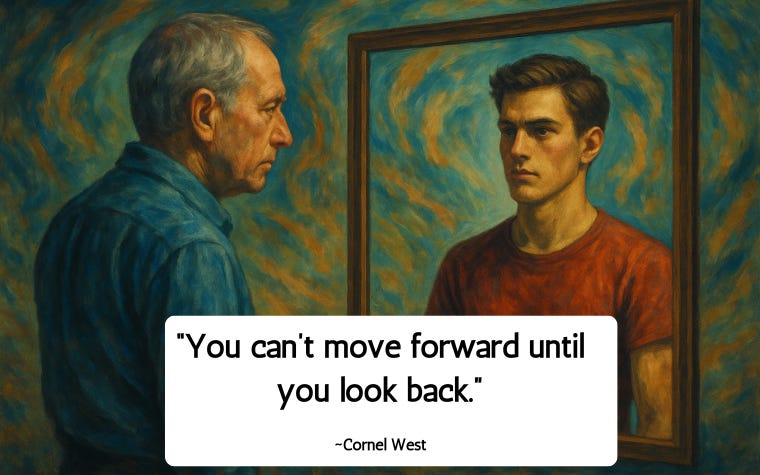
The last time I spoke with my dad, we were sitting in his living room when he announced he wanted to run another 5K. He'd need time to train and thought he'd be ready in three years. Then he asked if I would run it with him.
I thought it was a ludicrous idea, but I didn't want to disappoint my 96-year-old father. So I said yes.
My dad accomplished remarkable things in his long life. He served as a First Gunner's Mate aboard the U.S.S. St. Louis during the attack on Pearl Harbor. After the war, he worked as a journeyman plumber, eventually taking over the business and developing it into Burdick Contractors—a multi-state company. Along the way, he obtained his pilot's license and flew to visit his division offices.
All this with only a ninth-grade education.
A lifelong runner, my dad completed his first marathon in his 50s. He then challenged himself further, flying to Hawaii to complete his first Ironman at age 60.
When we sat in his living room that day, his 96-year-old mind remembered all he had accomplished. Running a 5K would be easy, he thought.
His body disagreed.
The Turning Point
My dad remained an active entrepreneur until his mid-70s. Even after selling his business, he stayed busy—investing in small companies, traveling, and training for triathlons.
Until he turned 84.
That's when he couldn't finish the swimming portion of a triathlon within the time limit. After that moment, his health declined. He wouldn't admit it, but physically, mentally, and emotionally, he felt lost.
Having purpose and control was central to my dad's identity and health. My siblings and I didn't understand this. We weren't old yet, so we naively thought he should just relax and not worry about anything.
He'd made many successful transitions throughout his life—from poor, uneducated kid to sailor, to business owner, to athlete. He had always controlled those changes. Old age, however, was thrust upon him. And he fought against it.
My dad was struggling with what Arthur C. Brooks calls "the Striver's Curse."
What Is the Striver's Curse?
In his book From Strength to Strength[1], Brooks describes the Striver's Curse as what happens when successful people who strive for excellence find they can no longer accomplish everything as they once did.
You feel anxious about not achieving your goals anymore. This anxiety makes even your successes increasingly unsatisfying. You secretly worry your best days are behind you. This striving attitude can also damage your relationships.
Are You a Striver Too?
You've been successful in life—especially in your career. You're proud of your accomplishments, experiences, and possessions.
But recently, you're feeling uneasy. Your achievements aren't as fulfilling as they once were. People used to hang on your every word. Now they see you as somewhat outdated.
(If this doesn't describe you, you're probably not a striver. But keep reading—you likely know strivers, and this will help you understand them better. It may also help you address your own fears about aging.)
You feel yourself slowing down, but you don't know what else to do. Your work (or identity as an athlete, parent, etc.) is your life. So like my dad, you keep going and deny the reality that you're changing.
Although you know you're aging, you don't think it will affect your performance until you're much older. This feeling of "I'm not old yet" is common. Even when you start wearing reading glasses, you might deny that you're aging.
This happens because you're addicted to the dopamine hit of success.
Others call it a strong work ethic. But it becomes an addiction when you pursue success at the expense of your health and relationships. After all, quitting is for quitters.
And quitters are forgotten.
The Fear of Irrelevance
The fear of becoming irrelevant is real as people age. If you become insignificant, what happens? We're social creatures who need to feel valued by our group. No one wants social isolation.
Feeling irrelevant—or better yet, "unseen"—happens when we compare ourselves to others and find ourselves lacking. If you've always felt ahead of your peers, falling off that pedestal means a long way down.
We all view ourselves through rose-colored glasses. As we age, our sense of being special can fade, which is disheartening.
You Can Change Your Path
This information might seem depressing, but it's meant to wake you up to reality: growing older means you can't keep doing the same things the same way. Grinding through life won't work anymore.
Physical and mental decline begins slowly—earlier than you'll notice. This happens to everyone.
Starting around age 40, your metabolism slows, energy declines, and muscles begin to shrink. Your brain processes information more slowly, and multitasking takes longer.
But this doesn't mean your ability to be productive and happy has ended.
There's a Better Way Forward
You can grow older and actually experience more meaning and happiness than ever before. The key is transcending your decline and finding a new kind of success.
This isn't wishful thinking—it's backed by scientific research.
Studies show that older people actually excel at certain types of thinking. Around age 50, your brain changes. You begin using both brain hemispheres[2] for tasks that younger people accomplish with only one side.
This bilateral brain use might not sound significant, but it allows you to generate more novel and better solutions to complex problems than younger people can. It gives you deepening judgment, perspective, and vision.
This growing wisdom and enhanced problem-solving ability will be the focus of our next issue.
[1] Brooks, Arthur C. (2022). From Strength to Strength: Finding Success, Happiness, and Deep Purpose in the Second Half of Life. Penguin. pg xiv
[2] Cohen, Gene D. (2006) The Mature Mind: The Positive Power of the Aging Brain, Perseus Books Group, loc 109