
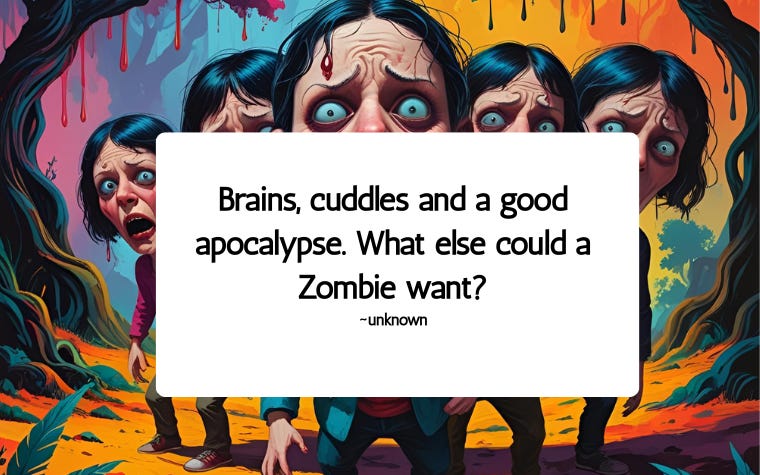
Zombies, vampires, mummies and other walking dead have fascinated people for centuries. Zombies, in particular, are more thrilling than terrifying.
Watching “The Walking Dead” (and other doomsday films) lets us yell at the screen over stupid decisions characters make. We get to vicariously experience scary things. We know Zombies aren’t real. Yet these situations help us navigate difficult circumstances in our real lives.
Three Lessons we can learn from a Zombie Apocalypse:
1. We need to confront our dark side.
We all have a dark side. Confronting it before it rears it’s ugly head can prevent fighting over toilet paper. We can decide to share instead. Or maybe we’ll stock up before store shelves are empty. (The Zombies may have won if they’d attacked during Covid-19!)
2. We are intrigued by survival.
Experiencing apocalyptic conditions (even in a movie theatre) sparks our imagination. It makes us feel lucky, alive, and daring. Surviving a vicarious catastrophe can help us Keep Calm and Carry On in real life.
3. We long to connect with others.
You survive a Zombie attack by banding together. Loners die - or are turned into more Zombies. (Is AI the new Zombie threat? It can be your girlfriend, and that leaves you as a loner.) Today it is challenging to connect with real people. But it’s worth the effort.
The lessons learned above don’t just help survive a mythical Zombie apocalypse. They can help you transition into the last decades of your life.
Consider - Zombies are made up (and so is retirement!)
Everyone knows Zombies aren’t real. But most people assume “the golden years” are the way to live when you get over a certain age. We’ve been raised to see our lives in three parts:
• Learning (birth thru mid 20’s)
• Producing (20’s thru 60’s)
• Retiring (60’s until death)
Many people feel healthy, vibrant, and productive through their old age. This is three decades we’re supposed to spend “retired.”
Retired means to withdraw.
And through most of history, retired people weren’t a thing.
People worked until they simply couldn’t. They became injured, frail, or mentally infirm. At that point, these elderly were cared for by their families or work guilds.
The first pension came about during the Civil War. It was a precursor to our current social security system.
And it was never about “the golden years.”
The golder years was an idea dreamed up by real estate developers. They created ads to sell homes in retirement communities. It was an old age of no problems and perpetual relaxation. One of these developers was Del Webb.
Del Webb created Sun City, Arizona in 1960. It wasn’t the first retirement community, but at 10,000 acres it was the largest. Ads for Sun City changed the way Americans thought about retirement.
The radio jingle for Sun City stated:
"Wake up and live in Sun City
For an active new way of life.
Wake up and live in Sun City
Mr. Senior Citizen and wife.
Don't let retirement get you down!
Be happy in Sun City; it's a paradise town."
Perhaps you envision your retirement as a Sun City time of pure leisure. You might need a looong vacation from a job you detest.
And that’s understandable.
But even if you can afford to spend 25 years on vacation, do you want to spend your last years doing nothing? It sounds great - now - but after a while, you will get bored. Or experience depression, as 1 in 3 retirees report (higher that the average).
This time is no longer THE Golden Years. It’s THE Time of Life on Your Terms
Or as I say, Your Time Ahead.
As you read this you might be thinking, “But I’m looking forward to retirement.”
“We look forward to retirement because we will finally get to relax and enjoy life. But people who have lived in a routine for 20 to 30 plus years have a difficult time transitioning into a space where there is no structured routine.”
So look forward to retiring from work. And consider how you have been spending your time and how it will change.
If you spent 40 plus hours a week as someone with a title, you had structure, purpose, and problems to solve. You worked while interacting with others at your workplace.
When you quit a full time job, you are thrown into a confrontation of the dark side as you suffer five significant, unavoidable losses[1]. These loses are the source of the depression mentioned above, and they include:
• Structure
• Relationships
• Identity
• A sense of purpose
• A sense of power
Structure: When you have a job, you have structure to your day. You have certain tasks that have to get done. Being adrift without this structure makes it easy to procrastinate. Procrastinate for a long time and you lose your sense of direction.
Relationships: Feeling like a fish out of water is normal when you don’t interact with colleagues every day. Even though some of those relationships may have been irritating, they were also familiar. And interacting with others regularly is good for your mental health.
Identity: Your identity is closely associated with your job title. Now, when others ask what you do, how do you answer? Developing a new identity comes from having a new purpose.
Purpose: Throughout your working life, a big part of your purpose was also tied to your job. Now that’s gone. You have to re-find yourself and re-purpose your life. Looking inside yourself to find this purpose can be uncomfortable.
Power: Achieving mastery and influence in your job usually takes years. And you probably left at the hight of your ability to influence others. This can seem like a huge letdown.
As you work through the above losses, you develop the vitality that comes through surviving something difficult.
You will also find your own way to connect with others through relationships and purpose.
What’s next?
I have intentionally left you hanging without solutions. This article is to get you thinking about what’s coming up in your time ahead.
There are no right or wrong answers.
Good decisions are based on good information. You’ve been given some good info. Now, think about what you’ve read.
Then forget it.
When you’re doing something mundane, like showering, walking the dog, or cooking, an idea will pop into your head. Write that idea down. Eventually you’ll figure out what you want the first part of your retirement to look like.
Until next time,
~Julie
P.S. Stay tuned - Zombies now, Sea Squirts next! And more goodies after that.
P.S.S. Something Fun: Sun City video from 1960:
[1] The Four Phases of Retirement: What to do, p 16