
Imagine walking into your U.S. History class in high school. What do you see? If your class was like mine, it was pretty much beige everywhere with a window looking out onto a concrete walkway.
It was a great place to take a nap.
My kids, however, had a different experience. They walked into class and saw a pirate ship hanging from the ceiling, a bunch of buccaneer paraphernalia plastered to the walls, and a huge treasure chest next to the teacher’s desk.
It was a great place to have fun - and learn at the same time.
They had an unusual teacher, Mr. Hansen. Mr. Hansen was unusual because he started teaching when he was in his 50’s. He’d sold a successful business and gotten a teaching certificate because he was bored. He taught history to share his love of the subject.
And he came up with all sorts of ways to teach that the kids loved; scavenger hunts, pirate raids, and regional food parties.
Mr. Hansen had learned to use his crystallized intelligence and excel at something he enjoyed.
Two Types of Intelligence
In 1971 Raymond Cattell, a British psychologist, wanted to know why some skills decrease as we age, and why some abilities don’t appear until later in life.
After years of research, he proposed that we have two types of intelligence:
The first he called fluid intelligence. This is the ability to reason, be flexible, and solve novel problems.
The second he called crystallized intelligence. This your ability to use all the knowledge you’ve accumulated over your lifetime.
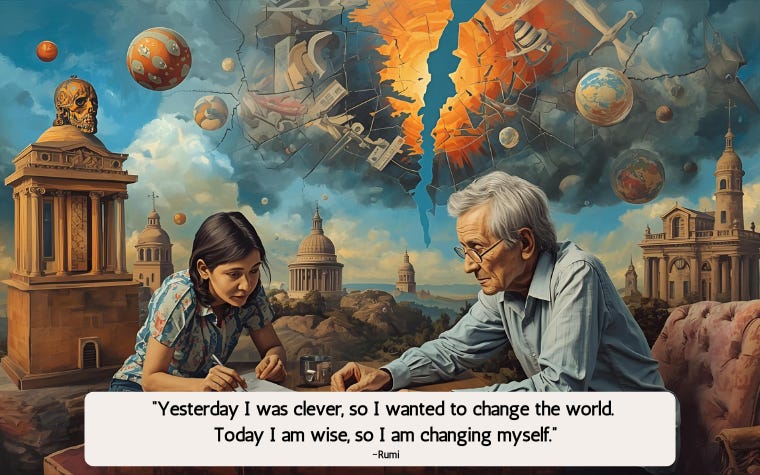
When you are young you have raw smarts, or fluid intelligence. When you are old, you have wisdom, or crystallized intelligence.
In other words, "When you are young, you can generate lots of facts; when you are old, you know what they mean and how to use them."[1]
The “Young Brain” X-Factor: Speed and Flexibility
Fluid intelligence helps you:
Think quickly on your feet in unfamiliar situations
Solve puzzles or problems you’ve never seen before
Manage multiple tasks at once
Learn new skills with ease
If you remember your 25-year-old self breezing through grad school, pulling all-nighters to get homework done, or multitasking your way through high-stakes projects—that’s fluid intelligence in action.
This quick, adaptable mental processing starts to decline in your late twenties. It’s so gradual you don’t notice it for decades.
As this type of intelligence slows down, however, your brain expands it’s neural network. It now uses crystallized intelligence.
The “Wise Brain” Superpower: Discernment
Crystallized intelligence is the accumulated knowledge, insight, and skills you've built over a lifetime. Unlike fluid intelligence, it doesn’t diminish with age—it actually gets stronger.
It includes your ability to:
Comprehend complex ideas
Recognize patterns based on experience
Exercise sound judgment and decision-making
See the bigger picture
In short: it’s everything you’ve learned through education, experience, and living.
Think of it this way: at 25, you could pick up a new software tool in a weekend. At 55, you can look at a messy workplace problem, instantly see three potential solutions, predict which one will work best, and anticipate side effects your younger colleagues wouldn’t even consider.
Your brain hasn’t lost the ability to learn new things. What’s changed is how it learns.
Rather than memorizing facts quickly (fluid intelligence), your brain is now more discerning. It excels at understanding deeper concepts and connecting new information to an existing framework of knowledge (crystallized intelligence).
The Great Trade-Up: Wisdom in Action
So why does this shift happen?
Because your brain isn’t done developing after your 20’s—it’s just getting more sophisticated.
In younger adults, brain activity tends to favor one hemisphere or the other for specific tasks. As you mature, your brain becomes more collaborative, using both side to integrate logic and creativity.
This creates entirely new capabilities.
Brain scans of people in their 50s, 60s, and beyond reveal something remarkable: while some areas may process information more slowly, the brain compensates by forming new neural pathways and activating regions younger brains don’t even use.
Your brain isn’t falling behind. It’s evolving!
The term for this is developmental intelligence. It’s the ability to trade speed for depth, reactivity for perspective, and surface-level thinking for real wisdom.[2]
This deepening wisdom, judgment, and perspective enables you to get better at what matters most in life, such as:
Improved Emotional Regulation: You are calmer than you were in your twenties because you handle stress and conflict better.
Enhanced Pattern Recognition: You see trends and connections that others miss—because you’ve seen them before.
Integrated Thinking: You can weigh multiple perspectives at once and find nuance in black-and-white issues.
Intuitive Wisdom: Your hard-earned experience translates into those gut feelings about people and decisions.
Why Society Gets This Wrong
Our youth-obsessed culture tells us faster is better. Younger is better. And prettier is better.
Guess what? Those “better’ things don’t translate into happier people.
The developed world’s obsession with youth has skewed our perception, especially in the workplace. Sure, a 22-year-old might come up with clever apps faster. But when it comes to understanding customer needs, predicting market shifts, or leading a team through a crisis—experience wins.
In an era where AI is rapidly replacing more routine, entry-level tasks, we’re seeing a growing appreciation for the depth and nuance that only experienced minds can offer.
So instead of thinking, “I’m not as sharp as I used to be,” Think:
“My brain has evolved from a race car into a high-precision navigation system.”
Your Time Ahead
Understanding how my thinking is evolving changes how I see my future. I hope it changes how you see your future as well.
I love how Mr. Hansen (the history teacher mentioned above) utilized his experience to create a life he enjoyed. And he did so in a way that made the world a better place.
His example gives me hope that I can figure out how to live the next decades in a way I enjoy, while also making the world a bit better.
What things would you like to do in the coming years?
Because you’re stepping into this mature season of life with:
Enhanced wisdom
Enlightened judgment
Elevated cognitive capabilities
The question isn’t whether you can keep up with your younger self.
The real question is:
Are you ready to stop chasing youth—and start leveraging the incredible intellectual strengths that come with the age you are?
Your brain hasn’t been getting worse.
It’s been preparing.
Preparing for what?
That’s what we’ll explore in the next article, as we dive into the four remarkable phases of adult brain development.
Keep learning,
~Julie
[1] Brooks, Arthur C. (2022). From Strength to Strength: Finding Success, Happiness, and Deep Purpose in the Second Half of Life. Penguin. pg xiv
[2] Cohen, Gene D. (2006) The Mature Mind: The Positive Power of the Aging Brain, Perseus Books Group, loc 109
And I thought I was getting slower & more forgetful! Instead I've been drilling into a life full of experiences! Thank you!